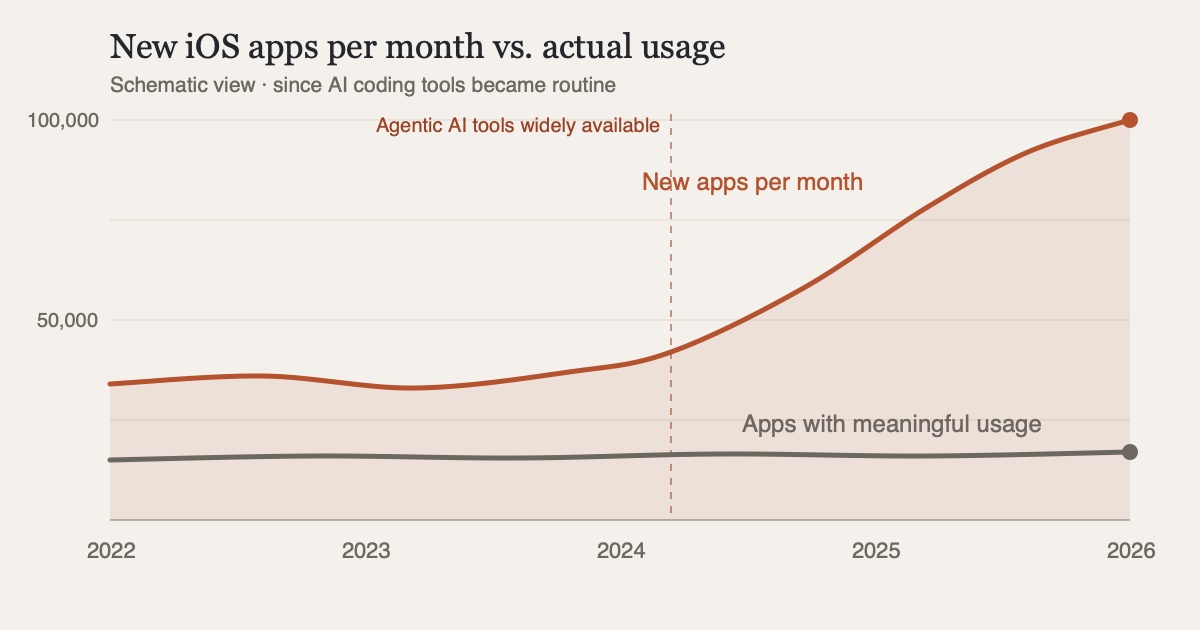
A Financial Times chart is making the rounds again, and it describes pretty accurately what I do on the side. I think the obvious reading of it is wrong.
What it shows: since agentic AI tools became widely available, the number of new iOS apps has exploded from roughly 30,000-50,000 to about 100,000 a month, and reviews have risen along with it. Actual usage, meanwhile, is flat to declining. The convenient headline right now is "AI is producing junk nobody wants."
I build my own apps with AI tools, and I'm genuinely proud of what I make with them. That is exactly why I think the headline is too short-sighted.
What the chart leaves out
Three things in the numbers aren't obvious at first glance.
The lines show total volumes, not per-app numbers. If releases nearly double while total reviews stay flat, reviews per app have collapsed, which is a lot more than "slightly declined". The same goes for usage: if it stays flat while the number of apps doubles, usage per app is cut in half. The traction problem is bigger than the chart shows.
"Apps with meaningful usage" stays flat. The flood barely creates new winners, but it doesn't destroy the existing ones either. Whoever already has users keeps them.
The bottleneck has moved. Writing code used to be the expensive part of building an app; today it's the cheapest step in the whole process. What's still scarce is knowing what to build, polishing it to completion, and getting people to trust you enough to use it.
What the research says
This lines up with the study behind the chart (Demirer, Musolff & Yang, MIT/Wharton): AI lifts coding activity by up to 180%, yet only about 30% of that shows up in actual releases. Humans remain the bottleneck.
Economists call this the "weak-link" thesis: a chain is limited by its weakest link, and AI simply doesn't accelerate every link at the same speed.
What I take away from this
Shipping is no longer a competitive advantage. Being able to say "I actually finished building it" used to be half a moat, and that moat has run dry.
If you want to stand out today, the building itself won't do it. You win before it (is this even worth building?) and after it (why would anyone find it and keep using it?).
For me that means less pride in how fast something gets built, even though I'm still stunned by how much faster building has become, and more energy for positioning, trust, and the one thing that makes an app different from the next interchangeable one in the same category.
So the chart doesn't indict AI apps. It indicts the idea that finishing something already counts as success.
I originally shared this thought on LinkedIn.