AI makes my job surprisingly easier, because I get much more done. At the same time, I am doing away with part of my own work. Then I read a study saying that language models and robots together could touch 81 percent of working time, and I ask myself: what are we supposed to tell young people today?
In short: the 81 percent describes what is technically within reach. It does not say how many jobs will disappear. The data on starting out still show a gap, in Germany too. How much of it is due to AI is open.
What the study measured
The research comes from Anthropic, a company that sells AI itself. It was published on 30 September 2026 under the title "What work can robots do?". Russell Legate-Yang and Maxim Massenkoff look at work in the United States, weighted by the time spent on each task.
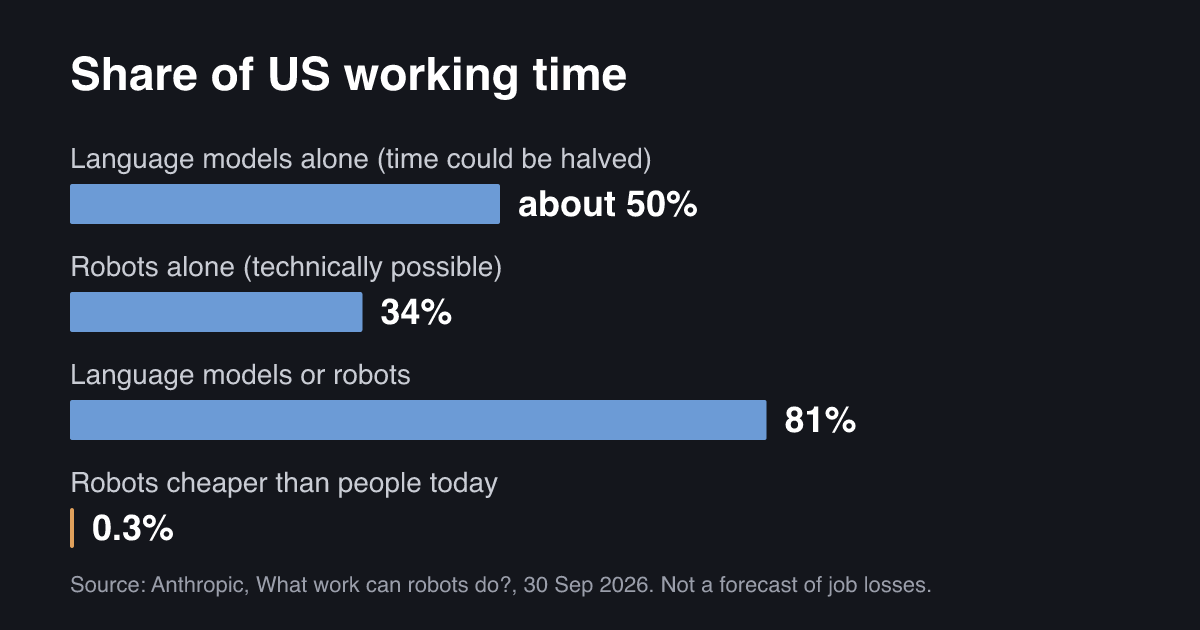
- Language models alone: about half of working time.
- Robots alone: 34 percent of all working time, which is around three quarters of physical tasks.
- Both together: 81 percent.
The two measures need explaining. For language models, the study uses an earlier measure: a task counts if a language model could halve the time it takes. That is different from doing the work on its own.
For robots, it is enough that a machine can do a task in an environment built for it, such as a factory assembly line. The evidence includes deployments, products on sale and also demonstrations. The individual tasks were rated by Claude, Anthropic's own AI model.
The gap between the figures shows which additional work robotics affects. In transportation, language models alone stay below 15 percent; with robots it is about 90 percent. For office and administrative work, the study arrives at nearly 100 percent. No occupation group is less than 40 percent exposed overall.
Technically possible is not yet affordable
The study also looks at cost, and here the picture shrinks: robots are cheaper than the people doing the work for only 0.3 percent of job tasks today. If costs keep falling as they have, by about 3 percent a year, it will take around 40 years to reach 10 percent of human work. If robots also become more capable, it goes faster. In a scenario with rapid progress, half of today's physical work would be cost-effective for robots by 2050.
This calculation applies to robots only. Software needs no factory hall, so the 40 years cannot be carried over to language models. Anyone working at a desk should not take comfort from that number.
The publication contains no forecast of lost jobs. It does not estimate new tasks that AI might create either. I also found nothing about people starting their careers on the page. Of course, that was not the focus. To me, that is exactly the flaw. For someone choosing a career, what gets added matters too.
Then there is the source. I would expect an AI company to make the possibilities of its technology look large rather than small. That does not make the figures wrong, but it is worth keeping in mind while reading them.
What can already be measured for new starters
People I know tell me about entry-level positions being replaced, and in some industries about jobs being cut wholesale. That does not count as statistics. Three analyses from this year get closer to the question.
For Germany, the ifo Institute reports that in the occupations most exposed to AI, full-time employment of 20 to 24-year-olds has fallen by 14 percent since the third quarter of 2022. Total employment in those occupations grew slightly over the same period. The analysis describes a development. According to its authors, it does not show that AI alone caused it. ifo President Clemens Fuest says he does not see broad job losses from AI so far.
Germany's Institute for Employment Research (IAB) is more cautious and calls its article, in German, an all-clear with reservations. Among 20 to 29-year-olds, full-time employment in 2025 was 3.8 percent below its 2022 level in highly exposed occupations and 2.6 percent below in the others. According to the IAB, the economic downturn has a clearly larger effect. The link with AI in this age group is becoming more negative but is not yet statistically significant. According to the IAB, however, there is a statistically significant negative link at least in manufacturing and in occupations that do not typically require a degree.
In the United States, the Stanford research group around Erik Brynjolfsson analyses payroll data up to June 2026. Employment of 22 to 25-year-olds in highly exposed occupations is about 19 percent below where it would be if it had kept pace with that of their peers in less exposed occupations. A year earlier, the gap was 15 percent. It arises mainly from hiring. It appears mainly where AI use tends to take over tasks. Where AI mostly supports people, there is no comparable pattern. The gap shrinks when education is taken into account, and some differences were visible before generative AI became widespread. These researchers also state clearly that their findings are descriptive and not causal estimates.
The numbers cannot be compared directly: different countries, age groups and periods. Taken together, I still see them as a warning sign. When fewer people are hired, it shows first among those who do not have a job yet. They do not appear in any layoff statistics.
The problem with the first step
Entry-level jobs often consist of exactly the tasks that are easy to hand off: research, summaries, first drafts, simple cases. Those tasks are where you learn what is later called experience. Handing them to AI saves time today. The open question is where, ten years from now, the people will come from who can judge whether the AI's result is correct.
I see this in my own work. Getting more done with AI depends on knowing what to ask for and when the result is wrong. I had that knowledge before. People starting out are supposed to acquire it now, while the practice tasks are becoming scarcer.
I have written before about why efficiency gains do not automatically mean less work, in the illusion of digital relief. The picture of the German labour market, where demographics weigh more than automation, still matters too. But a labour market that is stable on average is little help to someone who cannot get into it.
So what is the advice now?
I have no list of safe careers, and I would distrust any list that claims to be one. This is what I would say for now:
- Do not choose by the chart alone. It shows which tasks are technically affected, not which occupations will disappear. Interest still counts, because people rarely become good at something that does not interest them.
- Learn the basics by hand too. You need to be able to tell when an AI is producing nonsense.
- Use AI early and seriously. In the Stanford data, it makes a difference whether AI replaces tasks or supports people. You do not decide alone which side you end up on. Knowing how to use the tool will not hurt.
- Look for places where someone will teach you. When choosing training or a first job, I would ask: who will explain things to me here, and which tasks will I get to practise on?
This is advice for individuals, and it does not solve the actual problem. Companies that stop hiring beginners today will be looking for experienced people later. Training is still an investment even when an AI does the beginner's task faster. That responsibility cannot be pushed onto 19-year-olds.
What do you tell young people? I do not have a good answer yet.
FAQ
Will AI and robots replace 81 percent of all jobs? No. The 81 percent is a share of US working time that is technically exposed to language models or robots. The study does not predict how many jobs will disappear.
Are robots cheaper than people today? According to the study, only for 0.3 percent of job tasks. That calculation concerns robots, not language models.
Is AI already pushing out people starting their careers? In analyses from Germany and the United States, young people in highly exposed occupations are doing worse. How large AI's share in this is has not been settled. The IAB considers the economic downturn the stronger factor in Germany.
Sources
- Anthropic: What work can robots do?, Russell Legate-Yang and Maxim Massenkoff, 30 September 2026
- ifo Institute: Frühindikator zeigt starke Wirkung von KI auf Berufschancen von Einsteigern, press release of 9 November 2026 (in German)
- IAB-Forum: KI als Jobkiller für Berufseinsteiger? Entwarnung mit Vorbehalt, Arntz, Dinelli and Schlenker, 13 October 2026 (in German)
- Stanford Digital Economy Lab: Canaries in the Coal Mine? (PDF), Brynjolfsson, Chandar and Chen, revised August 2026