The debate about artificial intelligence and work has shifted noticeably in Germany. Just a few years ago, apocalyptic scenarios of mass unemployment dominated the headlines. Current studies by leading economic research institutes paint a far more nuanced picture. AI is turning out to be a catalyst that changes tasks across the board, and it may help against the labor shortage that demographic change is driving.
Shift, not destruction
Analyses by the Institute for Employment Research (IAB) and the Kiel Institute for the World Economy (IfW) agree that Germany's employment rate remains stable despite rapid technological progress. What is changing is the nature of the work itself. Researchers speak of a qualitative shift in job profiles rather than a quantitative destruction of jobs.
The scale is still remarkable. Over the next 15 years, AI-driven structural change is expected to affect an estimated 1.6 million jobs heavily. That rarely leads to layoffs, but the daily tasks within existing occupations are changing drastically.
The German peculiarity: the skills gap
The current PwC AI Jobs Barometer points to something particular about Germany: it is primarily a market of AI users. For every AI developer, there are roughly eight people applying AI in their work.
And that is exactly where things get stuck. While around 1.3 percent of all job postings already require explicit AI skills, the actual buildup of competence inside companies, so-called upskilling, lags behind. A gap is opening between what is technologically feasible and what the workforce can actually do.
Not all professions are affected equally
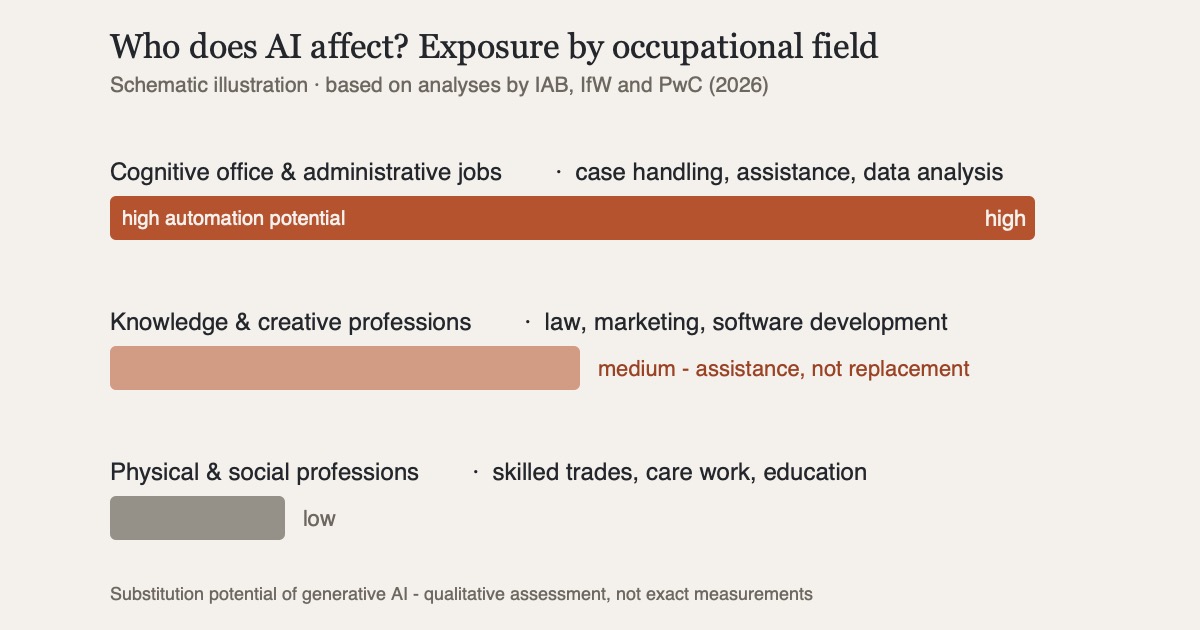
Unlike in previous waves of automation, this time it is mainly highly qualified, cognitive work that is affected, and some fields are hit much harder than others:
| Occupational field | Impact of AI | Outlook |
|---|---|---|
| Cognitive office and administrative jobs (case handling, assistance, data analysis) | High automation potential: standardized processes and text drafts are increasingly taken over. | Strong consolidation. Employees need to evolve into strategic reviewers and system managers. |
| Knowledge and creative professions (law, marketing, software development) | Enormous productivity gains through assistance systems (code generation, drafting, research). | No job losses, but changing requirements: those who use AI efficiently will, in the long run, replace those who don't. |
| Physical and social professions (skilled trades, care work, education) | Low substitution potential: AI mainly helps with documentation and organization. | Employment remains high and stable. The physical nature of the work protects the actual professional. |
The state's double role
On AI, the German federal government is pulled in two directions. It has to set the regulatory framework, not least in the context of the European EU AI Act, and at the same time it is expected to drive the modernization of its own administration.
Official guidelines such as the national digital and AI strategy claim a pioneering role for the state. In practice, implementation remains mostly piecemeal. Successful pilot projects do exist, such as AI-assisted job matching at the Federal Employment Agency or automated fraud detection in the customs administration. Yet according to a scenario report by the Fraunhofer Institute for Industrial Engineering (IAO), a comprehensive transformation of federal and state authorities is being held back by complex data protection hurdles, federalist structures and outdated IT infrastructure.
AI as an answer to demographic change
Despite these obstacles, the federal government sees AI as a major strategic opportunity. Parliamentary reports stress that the productivity gains from AI are strictly necessary to compensate for Germany's shrinking working-age population. In this view, AI is less a threat to employees than a tool to avert the looming collapse of services and administrative processes.
I recently explained why this equation does not work out automatically in a separate post on the illusion of digital relief: in a competitive economy, efficiency gains from AI often lead to higher expectations and more complexity rather than less work.
Conclusion: upskilling instead of fear
The technological disruption brought by AI is hitting a German labor market that already suffers from an acute labor shortage. It is precisely this overlap that softens the negative employment effects.
For policymakers and businesses, the central task in the coming years is therefore a large-scale upskilling offensive rather than containing unemployment. Only if this skill shift succeeds at scale, and bureaucratic hurdles in public administration are dismantled, can Germany tap the technology's full potential and secure its competitiveness.
Sources
- IAB: Artificial intelligence could raise GDP growth by 0.8 percentage points annually over the next 15 years (German), press release on the forecast that around 1.6 million jobs will be affected by AI-driven structural change
- Kiel Institute (IfW): AI is transforming job profiles, not employment, study based on labor market data from 2010 to 2023
- PwC: AI Jobs Barometer and the press release "AI reaches the core of the German job market" (German), analysis of job postings, including the 1.3 percent share of AI-related vacancies
- Fraunhofer IAO: study "Artificial intelligence in public administration" (German) and the scenario report "AI-based working worlds 2030" (PDF, German)
- Research Services of the German Bundestag: The impact of artificial intelligence on the labor market (PDF, German, WD 5-066/25)