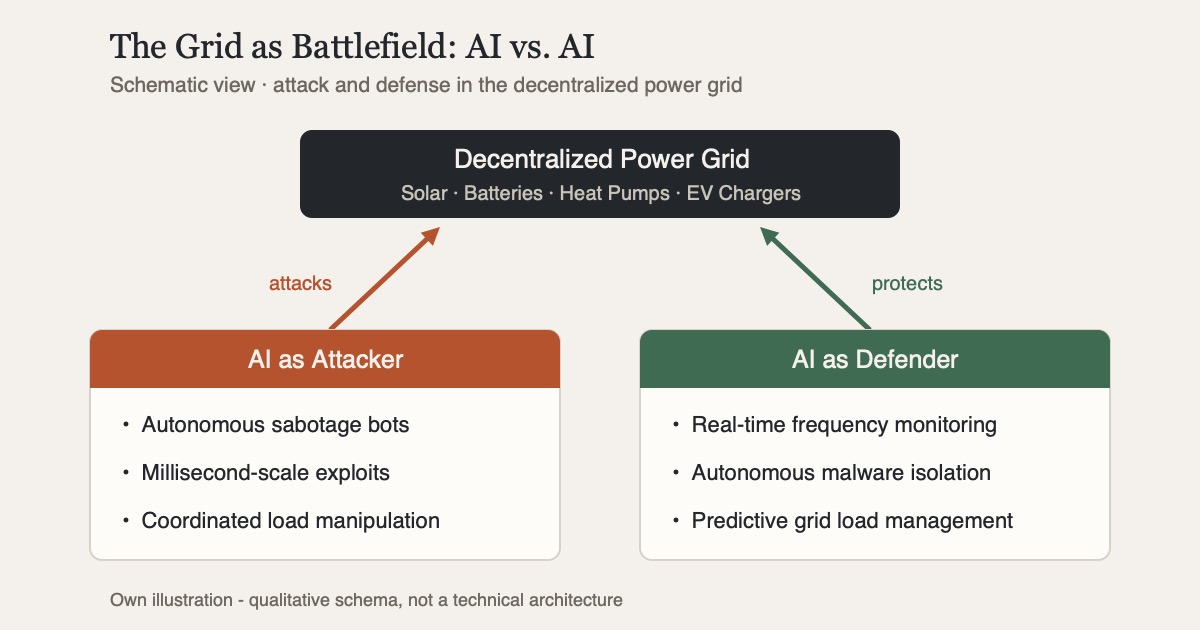
Power grids are critical infrastructure by definition. They are the nervous system of modern societies, which makes them a primary target for state actors and criminal hacking groups. And while energy systems are being rebuilt, the new AI threats hit them at a particularly weak spot: the digitalized grid is becoming a battlefield where machines fight machines.
From IT Security to Cognitive Sabotage
The energy transition has turned the once rigid power grid into a highly digital, decentralized mesh in which millions of photovoltaic systems, home battery storage units, heat pumps and EV chargers communicate with each other. Almost every modern inverter is permanently connected to the internet, often controlled through its manufacturer's cloud.
Offensive AI comes in right here. Attackers use automated AI agents to scan this vast, distributed attack surface for vulnerabilities at millisecond intervals. If malware gets into thousands of smart inverters or home storage systems this way, a new scenario becomes possible, namely coordinated manipulation. By simultaneously and abruptly switching large generators and consumers on or off, attackers could create artificial frequency fluctuations in the grid and, in the worst case, trigger regional blackouts.
A study by the testing institute DNV, commissioned by SolarPower Europe, shows how real this danger is. A hostile takeover of just around 3 gigawatts of inverter capacity would have a noticeable impact on the European interconnected grid, and from roughly 10 gigawatts on, Europe-wide blackouts become a real possibility. At the same time, several large manufacturers were each already able to remotely control more than 10 gigawatts of installed capacity in 2023. Germany's Federal Office for Information Security (BSI) has also been warning for years that a large share of the photovoltaic technology installed in Germany is insufficiently protected against external manipulation.
The Legal Backstop: The EU AI Act
Europe's regulation shows how seriously this threat is taken. The EU AI Act consistently classifies AI systems used as safety components for the control, monitoring and protection of critical electricity infrastructure as high-risk AI systems (Annex III). That puts them under strict requirements for cybersecurity, traceability and human oversight, including conformity assessments, technical documentation and ongoing post-market monitoring.
The Ambivalence: Why the Grid Cannot Survive Without AI
For all the risks, the modern, decentralized power grid of the future can no longer be operated stably without AI.
A few large power plants used to be controlled centrally. Now millions of volatile wind and solar installations feed in electricity depending on the weather. To balance this chaotic supply and demand, the defending side is turning to artificial intelligence as well: complex models use predictive time-series analysis to forecast generation and consumption with precision. If a sudden cloud front threatens to make the grid fluctuate, defensive AI systems react on their own within milliseconds, long before a human operator in the control center could intervene, and curtail large consumers or activate distributed battery storage.
Conclusion
The new generation of AI puts energy infrastructure to a stress test. Its physical hunger for energy forces a massive grid expansion, and it challenges cyber defenses by the second. At the same time, it gives grid operators the only tool capable of controlling a highly complex, decentralized energy system in real time. The power grid of the future will be secure only with the right AI on the right side.
Sources
- SolarPower Europe / DNV: Solutions for PV Cyber Risks to Grid Stability, study on cyber risks of connected inverters, simulation of the 3 GW and 10 GW scenarios
- pv magazine: BSI warns about Chinese manufacturers' access to German PV systems (German), BSI assessment of insufficiently secured, centrally controllable PV systems
- EU AI Act: Annex III - High-Risk AI Systems, classification of AI as a safety component of critical infrastructure (No. 2, incl. electricity supply)
- Future Energy Lab / Fraunhofer: Scientific report on AI in the power grid (PDF) (German), AI use cases for forecasting and grid operation