Part 2 of the series "Humans, Agents, Mandates: The Web Learns Identity". Part 1 showed why identity should belong to the person rather than the platform. Part 3 (When Your AI Agent Pays) follows on September 8.
For decades, the exciting question in computer science was: can a machine pass as human? In 2026 the question has flipped: can you prove you are not a machine? Deepfakes imitate voices and faces almost perfectly, synthetic identities populate social networks and job platforms, and with AI agents a new kind of actor arrives that does not pretend to be human at all - it legitimately acts on a human's behalf. The web therefore has to learn two things at once: recognizing humans as humans, and giving machines a verifiable, limited authority to act.
One half: prove you are a human
A classic login only proves that somebody knows a password - not that a single, real human is behind the account rather than a bot farm. This is exactly the gap personhood credentials are meant to close, known in the jargon as "proof of personhood".
The approaches differ mainly in where the trust anchor comes from:
- Personhood credentials: Researchers around the MIT Media Lab propose digital credentials issued by trusted authorities (such as government agencies) that attest exactly one statement: behind this account is a single, real human. First demos of such credentials are already running, implemented with verifiable credentials on a blockchain.
- Biometrics: World ID relies on the iris scanner "Orb": one human, one iris, one ID. That scales and is hard to fake, but it has an obvious price - you hand a biometric trait to a private network. The debate about this trade is entirely justified.
- Platform pragmatism: Reddit now labels accounts that are not run by a human and is evaluating a cascade of passkeys, third-party biometric personhood services and, if it must, government ID checks for verifying the rest.
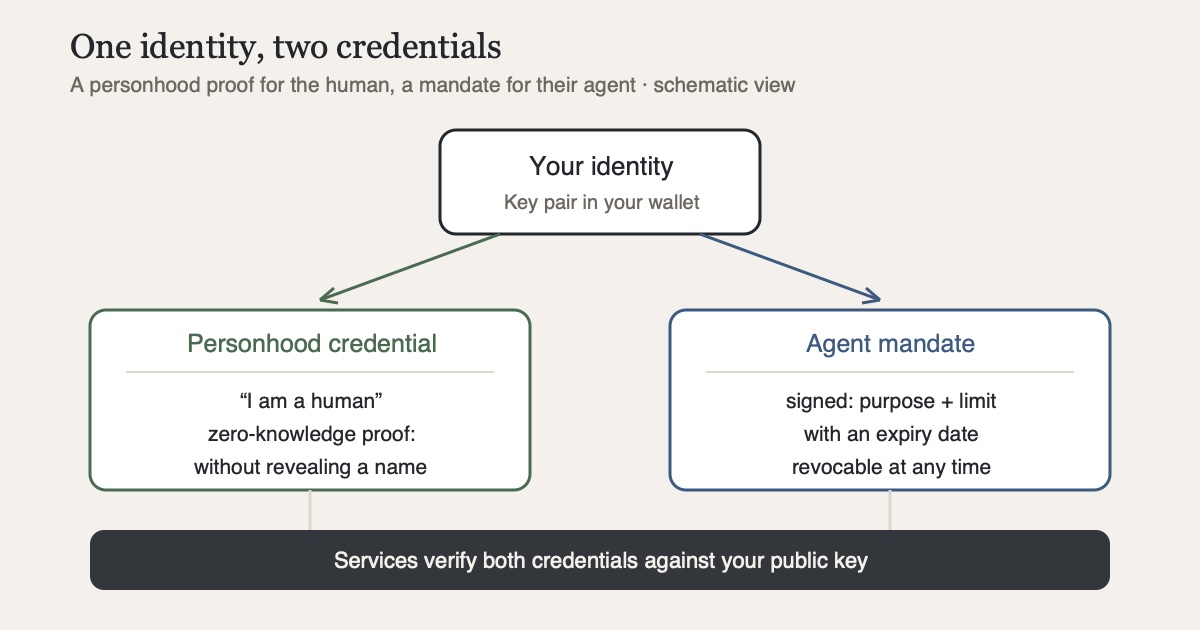
The technical key that makes all these approaches bearable is zero-knowledge proofs: I can prove cryptographically that I am a human (or of age, or unique per service) without revealing who I am. The credential belongs in your own identity wallet from part 1 - not in the database of every single platform.
The other half: agents with a mandate
In parallel, the opposite direction is pushing into the net. AI agents call tools, book appointments, spend money and delegate tasks to other agents. The two protocols this runs on today - MCP for tool calls, A2A for agent-to-agent communication - only govern how agents talk, not who they are. How big the gap is shows an analysis around the Agent Identity Protocol: a security scan of roughly 2,000 public MCP servers found not a single one with authentication.
IT's classic answer would be: just give the agent a service account and an API key. That is precisely what does not work, for a structural reason: traditional identity management is built around human sessions - login, bounded activity, logout. Agents, by contrast, run continuously, appear and disappear dynamically, switch contexts and hand tasks onward. A static API key with sweeping permissions is the wrong tool for this behavior: too much power, no expiry date, no link to the principal. Standardization bodies are now taking this seriously; the US institute NIST launched a dedicated AI agent standards initiative in early 2026 and is working on how identity principles can be applied to agents.
What is emerging instead is the model of the digital mandate: the agent does not get its own free-standing identity but a cryptographically signed authorization derived from my identity. Toward any service, it answers three questions:
- Who is behind it? The mandate is provably signed by my key.
- What may it do? Purpose, scope and limits are part of the mandate itself - say, "compare contracts and sign up to 40 euros monthly fee".
- How do I get rid of it? The mandate has an expiry date and can be revoked at any time, without me having to chase the agent.
Research proposals like the Agent Identity Protocol spell out exactly this for MCP and A2A: verifiable delegation across protocol boundaries.
Two sides of the same coin
Personhood credentials and agent mandates sound like separate construction sites, but they are the same problem from two directions: the web needs an answer to who is actually acting. And both answers presuppose the same foundation - an identity that belongs to the person and from which credentials can be derived. A platform identity cannot deliver that: Google cannot issue me a personhood credential that reveals nothing to Google, and a mandate bound to my Instagram account dies with it.
With that, the picture from part 1 comes together: the wallet with your own key pair is the anchor, the personhood credential is the human's ID, the mandate is their agent's ID. Which leaves the question of where this model reaches everyday life first. The answer is as obvious as it is logical: where mistakes immediately cost money. Visa, Mastercard, Stripe and the crypto world are racing to build the infrastructure that lets agents pay - that is the subject of part 3 on September 8.
Sources
- MIT Media Lab: How "personhood credentials" could help prove you're a human online - the concept of personhood credentials from trusted issuers
- LF Decentralized Trust: Proof of Personhood in Action: The First Person Credentials Demo on Hedera - first implementation with verifiable credentials
- Crypto Adventure: Proof of Personhood Explained: World ID, zk Credentials, and the Tradeoffs - World ID, the Orb and the trade-offs of biometrics
- Biometric Update: Reddit adds labeling for non-human accounts, weighs personhood verification methods - labeling and planned verification methods
- arXiv: AIP: Agent Identity Protocol for Verifiable Delegation Across MCP and A2A - the identity gap in MCP/A2A, scan of roughly 2,000 MCP servers, verifiable delegation
- Strata: A New Identity Playbook for AI Agents in 2026 - why classic IAM breaks for agents, NIST initiative in early 2026
- Okta: What is AI agent identity? - the view of an identity provider