There's a moment when many photographers question their Adobe subscription: the next price increase. In 2025 it happened again - the classic photography plan with 20 GB rose from 11.83 to 17.99 euros a month in Germany, and for new customers it was replaced by more expensive 1 TB plans. Stop paying, and you lose the ability to edit your own pictures. As a Pentax photographer with a K-1, I made the jump - to DxO PhotoLab, with a perpetual license. Here's the honest balance.
The math: one-time purchase versus perpetual subscription
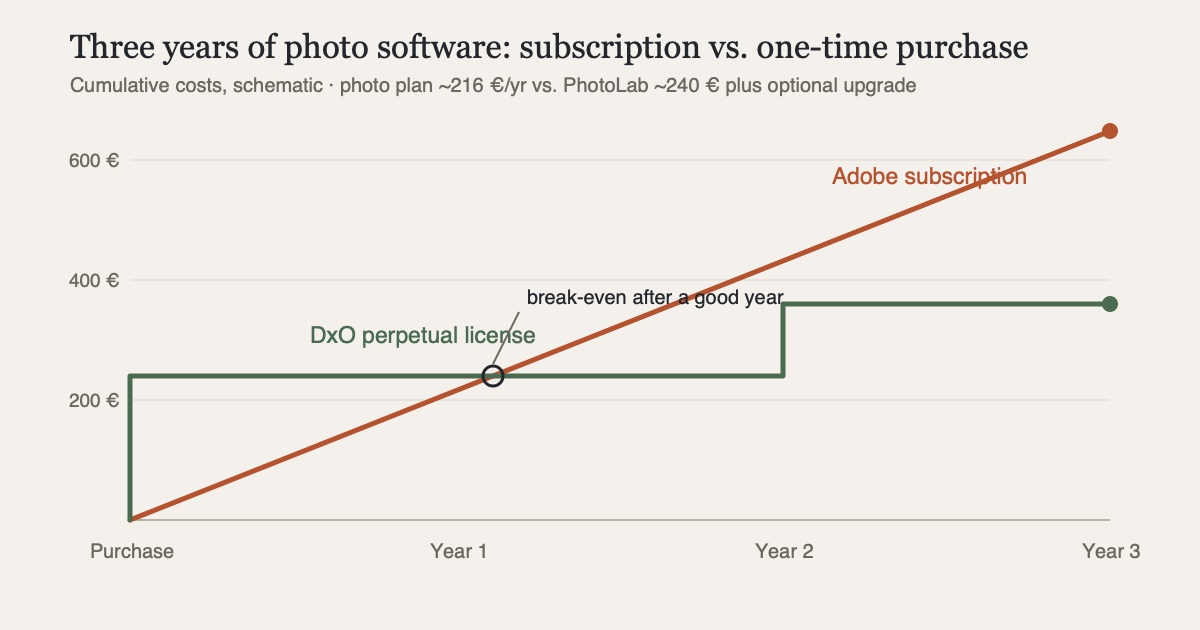
DxO PhotoLab 9 costs around 240 euros in the Elite edition - once. Upgrades to new major versions are optional at roughly half that; skip a version and you lose nothing, the software keeps working. Measured against the current photography plan (around 216 euros per year), the license pays for itself in a good year. After that you keep shooting for free - and you retain the ability to edit your RAWs even if you skip upgrades for two years. A 30-day trial takes the risk out of switching.
Why DxO of all things
Three technical reasons tipped the scales for me:
- DeepPRIME denoising. DxO's neural denoising has been the reference for years. The current generation, DeepPRIME XD3, delivers roughly three stops: ISO 12,800 looks like ISO 1,600, without the waxy artifacts of classic denoisers. Since version 9.6, XD3 also works with Bayer sensors - including the full-frame sensor of my K-1. For available-light and dusk landscape photography, it's the single biggest quality jump in the workflow
- Calibrated optics modules. DxO measures camera-lens combinations in the lab - by now over 111,000 modules, with more than 90 lens profiles for the K-1 alone. Distortion, vignetting, chromatic aberration and lens-specific sharpness correction happen automatically and more precisely than with generic profiles
- Local adjustments without layer gymnastics. The U Point technology and version 9's AI masks handle 90 percent of what used to send me over to Photoshop
The workflow in practice
PhotoLab doesn't force a catalog on you: it works directly on your folder structure, and edits are stored as sidecar files next to the RAWs. My routine: dump the card into a date-based folder, cull in the PhotoLibrary, edit (usually just a preset plus fine-tuning, DeepPRIME at export), export finished JPEGs to the gallery. A normal backup covers the RAW folders - no cloud, no sync service, no platform trying to keep me. The pictures on my photography page came about exactly this way.
The honest limits
A fair comparison also names what's missing:
- No cloud ecosystem. Lightroom's seamless phone-tablet-desktop sync doesn't exist here. If you want to edit on an iPad on the go, DxO won't make you happy
- Asset management is an afterthought. The PhotoLibrary can cull, star and group projects - but it's no full DAM. My answer is a disciplined folder structure; anyone searching tens of thousands of images by face recognition needs an additional tool
- DeepPRIME costs compute. Denoising runs at export and wants a decent GPU; on older machines the export queue becomes a coffee break
- Ecosystem gaps. Third-party plugins, tutorials, presets - Adobe's universe is bigger. Then again, with DxO the need for add-on tools is smaller
Conclusion
Leaving the Adobe subscription wasn't an act of defiance for me but sober arithmetic that looks better with every price round: after a good year the perpetual license is paid off, and image quality didn't get worse through DeepPRIME and the optics modules - it measurably improved. The price is giving up Adobe's cloud convenience and a piece of its ecosystem. For my use case - RAW development on the Mac, folders instead of cloud, quality over sync - it's a trade I'd make again any time.
Sources
- fotowissen.eu: Adobe raises prices for Lightroom/Photoshop - photography plan up from 11.83 to 17.99 euros monthly
- 5reicherts.com: Adobe Lightroom - important changes in the subscription model - end of the 20 GB photography plan for new customers
- DxO: Shop with current license prices - PhotoLab 9 Elite as a perpetual license
- fotoMAGAZIN: PhotoLab 9.6 arrives with DeepPRIME XD3 - roughly three stops of noise improvement
- DOCMA: DxO releases PhotoLab 9.6 with DeepPRIME XD3 for Bayer sensors - XD3 expansion and AI masks
- DxO: Supported Cameras & Lenses - calibrated optics modules, including the Pentax K-1