It's a sight that puzzles many people. A fresh northwesterly is blowing, but the wind turbines along the coast stand still. They are switched off, not broken. At the same time the power exchange reports negative prices, so whoever takes electricity gets paid for it. Both sound absurd in a country that needs every kilowatt-hour of green power. They are in fact two different phenomena with a common core: generation, grid and demand don't yet match in time and space.
Redispatch: traffic jam on the electricity highway
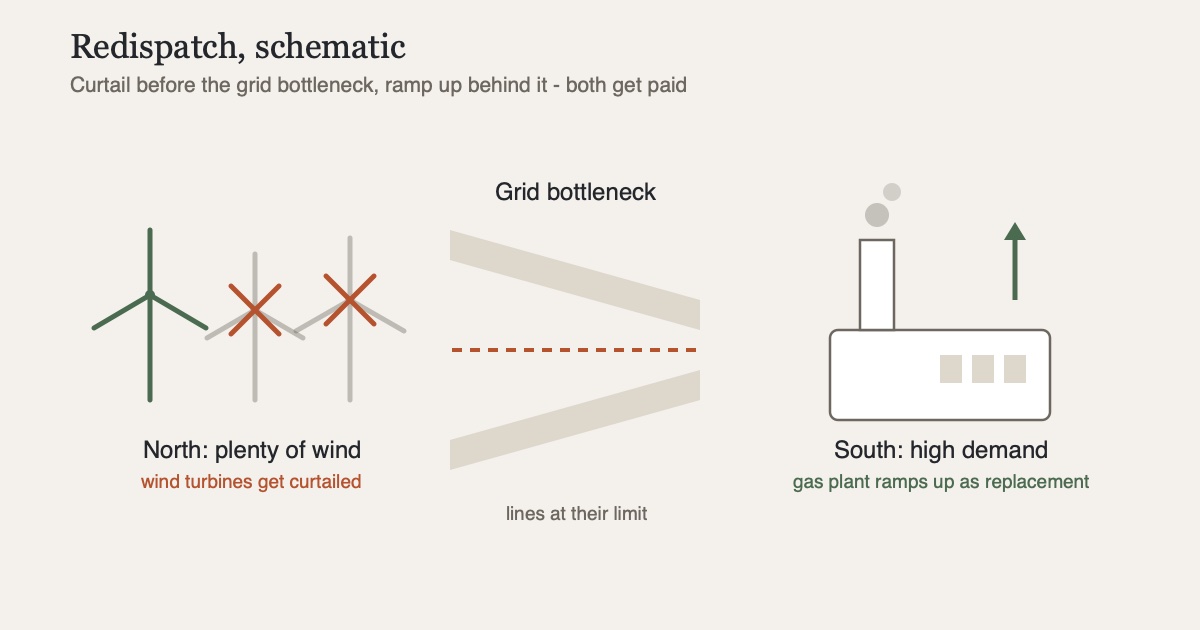
Germany's transmission grid was historically not built to carry large volumes of wind power from the coast to the industrial centers in the south. When the north generates more than the lines southward can carry, grid operators have to intervene. That intervention is redispatch: power plants before the bottleneck are throttled (the idle wind turbines), and plants behind the bottleneck ramp up (often gas plants in the south). The grid stays physically stable, but the bill is paid twice, once as compensation for the curtailed wind power and again for the replacement power.
The sums are large. Total grid congestion management cost around 2.8 billion euros in 2024, including more than half a billion in compensation for curtailed renewables. And the pressure grows with the buildout: curtailment of photovoltaics nearly doubled in 2024. There is enough power. It just doesn't get to where it's needed.
Negative prices: when feeding in costs money
The second phenomenon plays out on the exchange. Prices form there by auction: if more generation is offered than demanded, the price falls, below zero if necessary. Then producers pay to get rid of their power. They keep running anyway, for two reasons. Conventional plants can't be switched off and on at will, and renewables long received their feed-in payment even when the market price was negative, so feeding in still paid off for them when nobody needed the power.
The trend is steep: 457 hours of negative day-ahead prices in 2024, 573 hours in the record year 2025, driven above all by the photovoltaic boom in the spring and summer months. The first half of 2025 alone saw 389 hours. Remarkably, electricity was still more expensive on average in 2025 than in 2024. Negative hours and high average prices don't contradict each other, because volatility increases at both ends.
What is changing now
Lawmakers have responded to the imbalance. Since February 25, 2025, Germany's so-called solar peak law has been in force: new installations from 2 kilowatts up no longer receive feed-in payments during periods of negative prices, starting from the very first quarter-hour. In return, the subsidy period is extended accordingly (Sections 51 and 51a of the Renewable Energy Act). For the first time, even small systems are better off storing the power or using it themselves during a glut than feeding it in.
The remaining building blocks of the solution are the same ones this blog has been following:
- Storage absorbs the midday peak and shifts it into the evening. Why its buildout is stuck at the grid connection is covered in the post on battery storage
- Flexible demand turns the problem into an advantage: charge your EV during negative price hours on a dynamic electricity tariff and you're effectively rewarded for consuming
- Grid expansion remains the structural answer to redispatch, but corridors like SuedLink take years, and flexibility is the bridge until then
Conclusion
Wind turbines standing still in perfect wind do not mean the energy transition is failing. They are the visible symptom of a system whose generation has grown faster than its grid, storage and market design. The numbers show the problem (billions for congestion management, record negative hours) as well as the direction of the solution (storage, flexible demand, payments only when power is actually needed). The faster consumption and generation find each other, the rarer the puzzling image of the switched-off wind turbine becomes.
Sources
- SMARD (Bundesnetzagentur): Grid congestion management 2024 - volume and costs down, 2.776 billion euros total costs, around 554 million euros in renewables compensation
- pv magazine: Curtailment of photovoltaic systems rose 97 percent in 2024, doubling of PV curtailment
- ZFK: 2025: power was expensive to buy, yet there were more negative price hours, 573 negative hours in 2025 after 457 in 2024, average price 89.32 euros/MWh
- pv magazine: Day-ahead electricity prices negative in 389 hours in the first half, half-year figures for 2025
- Klimaschutz- und Energieagentur Niedersachsen: Solar peak law in force - what changes for new PV systems?, rules since February 25, 2025
- Clearingstelle EEG/KWKG: Is my system's payment reduced because of negative prices?, Sections 51/51a EEG and the compensation mechanism