You tell yourself you'll have just a handful of chips. Moments later your hand hits the bottom of an empty bag, and the strange part isn't the guilt - it's that you don't even feel particularly full. This is not a failure of willpower. Certain snacks are deliberately engineered to bypass the very signals the body uses to say "enough." Food science has a name for it: vanishing caloric density.
The trick is to disappear fast
The term was coined by food scientist Steven Witherly in his report Why Humans Like Junk Food. The idea is as simple as it is devious: when a food collapses in the mouth almost instantly, the brain registers barely any caloric load - even though a substantial amount of fat and starch is actually going down. The food seems to vanish before it even counts.
Witherly's go-to example is Cheetos, which he calls one of the "marvelously constructed foods on the planet, in terms of pure pleasure." On the effect itself, he is quoted directly in James Clear's widely read analysis What Happens to Your Brain When You Eat Junk Food: "If something melts down quickly, your brain thinks that there's no calories in it … you can just keep eating it forever." That last clause is the whole point: no perceived calories, no reason to stop.
Why chewing is really the stop button
Chewing is more than breaking food down. It is one of the signals that prompts the digestive tract to start releasing satiety hormones. A 2013 study in the British Journal of Nutrition by Zhu, Hsu, and Hollis measured exactly this: more chews per bite led to less hunger afterward and to changes in the satiety hormones GLP-1 and CCK, while appetite-driving ghrelin dropped (study via PubMed). Put simply: the longer your mouth works, the sooner your body reports that it's had enough.
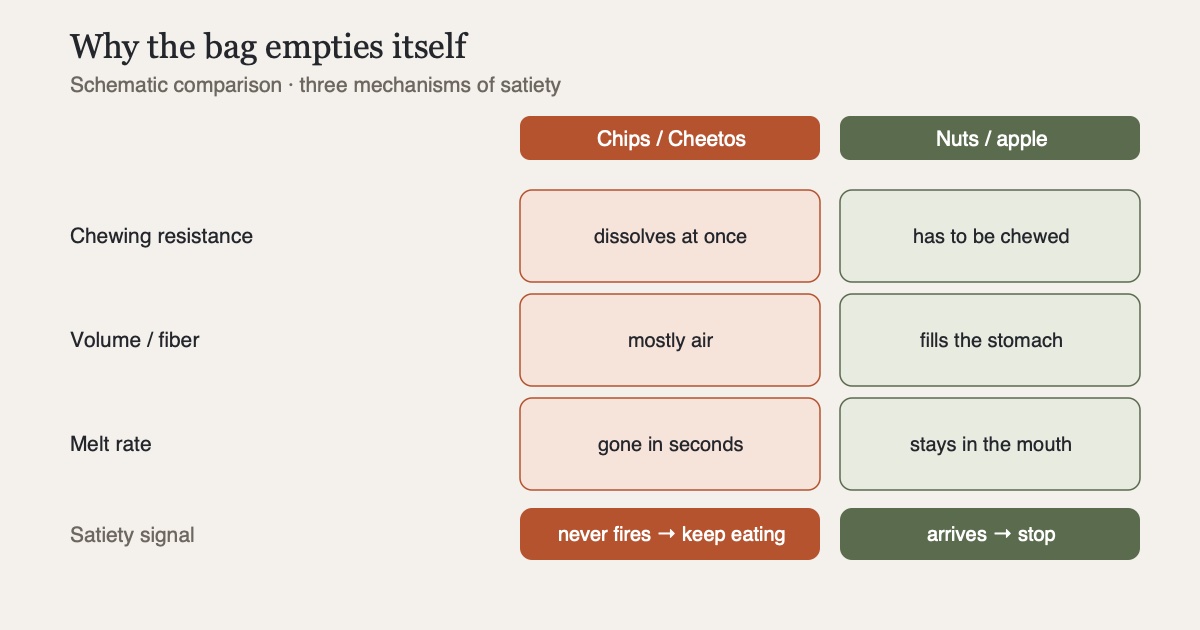
A snack that dissolves on the tongue skips this mechanism almost entirely. It is barely chewed - closer to swallowed - and the trigger for the satiety cascade simply never fires. Then there is missing volume. Fiber and water give unprocessed foods bulk that the stomach detects through its stretch receptors. Extruded, aerated snacks, by contrast, are mostly air. You can take in a lot of calories without the stomach registering much fullness at all.
The bliss point does the rest
The melt effect alone wouldn't keep anyone eating - a flavorless piece of styrofoam also dissolves quickly in the mouth. What matters is the combination with the so-called bliss point. Market researcher and psychophysicist Howard Moskowitz developed the concept for the food industry in the 1970s: the exact blend of sugar, fat, and salt at which preference for a product peaks, without any single ingredient standing out unpleasantly (see Wikipedia on the bliss point)). These three ingredients don't just add up, they reinforce one another - which is why manufacturers fine-tune the mix through extensive testing.
Assembled together, this produces a product that attacks satiety on three fronts at once: minimal chewing resistance, minimal volume, and a flavor profile sitting right at the reward optimum. For our brain's evolutionary logic - lots of energy for minimal effort reads as a good find - that combination is hard to turn down. The blood sugar that spikes and crashes moments later doesn't factor in while you're snacking; the reward system knows only one demand: more.
Sonic branding: the sound is designed too
One often overlooked lever is the sound. The snap as you bite in, the crunch as you chew - none of it is accidental; it is a designed signal, sometimes called sonic branding. Just how much sound steers perception was shown by Oxford psychologists Massimiliano Zampini and Charles Spence in 2004: in their study, participants bit into chips while their own crunching sound was fed back through headphones in manipulated form. Boosting the volume, or just the high frequencies, made people rate the very same chips as crisper and fresher (Journal of Sensory Studies). The work earned the tongue-in-cheek Ig Nobel Prize in 2008 - but the effect itself is well documented.
Crispness reads unconsciously as a marker of freshness, and a sharp crunch reinforces the pleasure with every bite. That's why the sound is engineered right alongside the recipe - from the cell structure of the snack to the rustle of the packaging. It, too, is a sensory cue that invites you to keep eating, without a single calorie being involved.
How to get out of the trap
You don't have to give anything up, but knowing the mechanism already changes how you reach into the supermarket shelf. Three approaches help concretely:
- Favor chewing resistance. Nuts, vegetable sticks with hummus, or apple slices demand real chewing - and are more likely to trigger a satiety signal.
- Read the ingredient list. A long run of modified starches, fats, and flavorings is a sign the product was optimized for overeating.
- Portion it out instead of eating from the bag. Pouring a small bowl and putting the pack away interrupts the automatic reach-and-eat reflex that empties an open bag so reliably.
Ultra-processed snacks are masters of deception: they make the body believe it's eating lightly while flooding it with calories. Knowing about vanishing caloric density won't automatically make you eat less - but you'll understand why the bag seems to empty itself, and that's already half the way back to control.
Sources
- Steven Witherly: Why Humans Like Junk Food (IFT presentation, 2007) - origin of the term "vanishing caloric density"
- James Clear: What Happens to Your Brain When You Eat Junk Food - direct Witherly quote on the Cheetos example
- Wikipedia: Bliss point (food)) - background on the term and Howard Moskowitz's role
- Zampini, M., Spence, C. (2004): The role of auditory cues in modulating the perceived crispness and staleness of potato chips, Journal of Sensory Studies - crunch sound alters perceived freshness
- Zhu, Y., Hsu, W. H., Hollis, J. H. (2013): Increasing the number of masticatory cycles is associated with reduced appetite and altered postprandial plasma concentrations of gut hormones, insulin and glucose, British Journal of Nutrition - link between chewing and satiety hormones