Germany aims to be greenhouse gas neutral by 2045. But how do you supply an industrial nation of more than 80 million people entirely without coal, oil, and natural gas? The Fraunhofer Institute for Solar Energy Systems (ISE) has given a remarkably concrete answer: its study "Paths to a Climate-Neutral Energy System - Federal States in the Transformation Process" (November 2024, updated in spring 2025) is the first to model the transformation with regional resolution at the level of the federal states, including the required expansion of electricity and hydrogen networks. Combined with the analyses from Agora Energiewende and the Ariadne research consortium, a strikingly consistent picture emerges: climate neutrality is technically feasible and economically sensible. The most expensive option is waiting.
Four scenarios, one goal
The ISE uses its cross-sector energy system model REMod, which computationally replicates the German energy system including imports and calculates the cheapest transformation paths. Four scenarios map out the range of possibilities:
- Technology-open: the cost-optimized path without additional constraints, with maximum freedom in the choice of technologies.
- Efficiency: tightened climate targets (1,000 megatonnes less CO₂ by 2045), faster expansion of solar and wind, and falling energy demand through efficiency and sufficiency.
- Persistence: combustion engines and fossil heating systems are kept longer, and the industrial transformation is delayed.
- Robust: geopolitical crises, such as reduced availability of photovoltaic systems and battery storage, slow down the buildout.
All four paths reach the climate targets and keep the energy supply secure in every hour of the year. They differ drastically in cost, though (more on that below).
The foundation: radical electrification
The most important finding of all modern energy system studies dispels a widespread misconception: we will not simply replace fossil fuels one-to-one with hydrogen or e-fuels in cars and basements. That would be far too inefficient and too expensive.
Instead, according to the ISE, direct electrification is the cheapest option for the system as a whole wherever it is technically possible:
- Heat pumps are the dominant heating technology in 2045.
- Passenger transport runs almost exclusively on battery-electric vehicles.
- The degree of electrification in industry rises to around 70 percent.
Hydrogen does not disappear from the picture, but its role is clearly defined: high-temperature processes and feedstock use in industry, parts of the transport sector, and flexible power plants that step in when wind and sun take a break. Around 96 gigawatts of hydrogen power plants back up the system in the technology-open scenario; roughly two thirds of the hydrogen demand is imported.
The Ariadne scenario report, a comparison of six independent energy system models, confirms this finding: the share of electricity in final energy consumption rises in all target scenarios from 18 percent (2019) to 40 to 69 percent in 2045. Electrification is the common denominator of every serious path to climate neutrality.
The consequence: electricity demand doubles
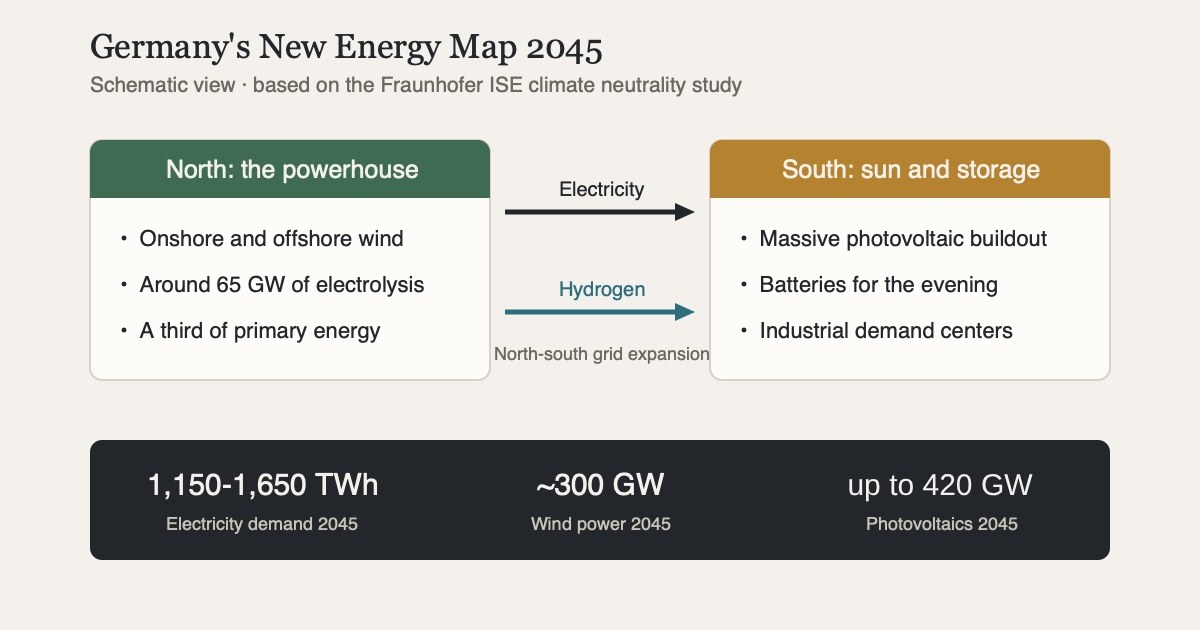
Driven by heat pumps, electric cars, and electrified industrial processes, the ISE expects electricity demand to double in every federal state by 2045. Depending on the scenario, total electricity demand in 2045 ranges between 1,150 and 1,650 terawatt hours, two to three times today's consumption. But because heat pumps and electric motors use energy far more efficiently than combustion processes, the country's primary energy demand falls significantly at the same time.
This demand is met almost entirely by wind and sun: in the cost-optimal scenario, onshore and offshore wind together reach roughly 290 to 310 gigawatts, and photovoltaics grows to up to 420 gigawatts, a multiple of today's capacities. Nuclear power or continued operation of fossil plants play no role in the cost-optimized calculations, simply because wind and solar are the cheapest sources of electricity.
Germany's new energy map
The real added value of the ISE study lies in its regional perspective, which no comparable work has offered before. The energy transition reshuffles the roles of the federal states:
- The north becomes the nation's power plant. Thanks to their wind power potential, Lower Saxony, Schleswig-Holstein, and Mecklenburg-Western Pomerania provide a third of Germany's primary energy in 2045. At the same time, domestic hydrogen electrolysis emerges there as a major new electricity consumer: the bulk of the expected 65 gigawatts of electrolysis capacity is installed in the north.
- The south bets on sun and storage. In photovoltaic-dominated states like Bavaria and Baden-Württemberg, battery storage is added at scale to shift midday solar power into the evening.
- The connection is decisive. Transporting electricity and hydrogen from the north to the industrial demand centers of North Rhine-Westphalia, Baden-Württemberg, and Bavaria requires significantly more grid expansion, especially along the north-south and north-west corridors, plus hydrogen storage of at least 130 terawatt hours.
The success of the energy transition therefore depends less on individual technologies than on how they work together: generation, grids, storage, and flexible demand have to be planned together. I covered why the interplay of storage and grid is still jammed today in my post on battery storage as the backbone of the energy transition.
The cost of hesitation
The study is remarkably candid about money. In the technology-open scenario, the transformation costs an average of around 52 billion euros per year over 25 years, compared with simply continuing today's system. That is about 1.2 percent of today's gross domestic product. Agora Energiewende adds context in its 2024 study "Climate-Neutral Germany": roughly three quarters of the required investments are due anyway, for example when old heating systems, cars, and industrial plants need replacing. Climate policy merely steers these investments toward the future-proof option.
The real dynamite is in the scenario comparison of CO₂ abatement costs:
| Scenario | Average abatement costs (2024 to 2045) |
|---|---|
| Efficiency | just under 90 euros per tonne of CO₂ |
| Technology-open | just under 220 euros per tonne of CO₂ |
| Persistence | just under 320 euros per tonne of CO₂ |
Clinging to combustion engines and fossil heating looks like the comfortable option and turns out to be the most expensive one. The reason: whoever wants to reach the climate targets despite a delayed transition must eventually import large amounts of expensive synthetic fuels and rely heavily on negative emission technologies. The Ariadne consortium reaches the same conclusion and warns emphatically about lock-in effects: buildings, infrastructure, and industrial plants live for decades, which is why investment decisions made in the 2020s already have to be compatible with climate neutrality. Every gas boiler installed today is a mortgage on 2045.
Conversely, the efficiency scenario shows that faster buildout plus lower consumption cut abatement costs to less than half of the cost-optimal path. In this transformation, speed is not a risk but the biggest cost lever.
Conclusion
Science has laid the tracks, with rare unanimity across institutes and models: a climate-neutral Germany in 2045 rests on massive direct electrification, a multiplied buildout of wind and solar, hydrogen used where it counts, and a new division of labor between north and south. Technically, the path has been calculated through; economically, it is cheaper than any business as usual. What is missing is not another study but implementation speed: in permitting, in grid expansion, and in making the system flexible. The bill for hesitation is now in black and white, at just under 320 euros per avoided tonne of CO₂ instead of 90.
Sources
- Fraunhofer ISE: Paths to a Climate-Neutral Energy System - Federal States in the Transformation Process, study page with download, first published November 2024, updated version spring 2025 (German)
- Fraunhofer ISE: Press release on the study (PDF), scenarios, electricity demand of 1,150 to 1,650 TWh, 290 GW wind, up to 420 GW PV, 65 GW electrolysis, 130 TWh hydrogen storage, scenario costs (German)
- pv magazine: ISE study describes a "climate-neutral Germany", further figures from the study, including 96 GW of hydrogen power plants, hydrogen import share, around 350 GWh of battery storage (German)
- Agora Energiewende: Climate-Neutral Germany: From Target Setting to Implementation, investment needs averaging 11.2 percent of GDP, three quarters of which are due anyway (German)
- Ariadne project: Germany on the Path to Climate Neutrality 2045 - Scenarios and Paths in Model Comparison, model comparison, electricity share of final energy of 40 to 69 percent, path dependencies and lock-in risks (German)
- Ariadne project: Designing the Energy Transition Cost-Efficiently - Scenarios for Climate Neutrality 2045, updated scenario report from March 2025 (German)