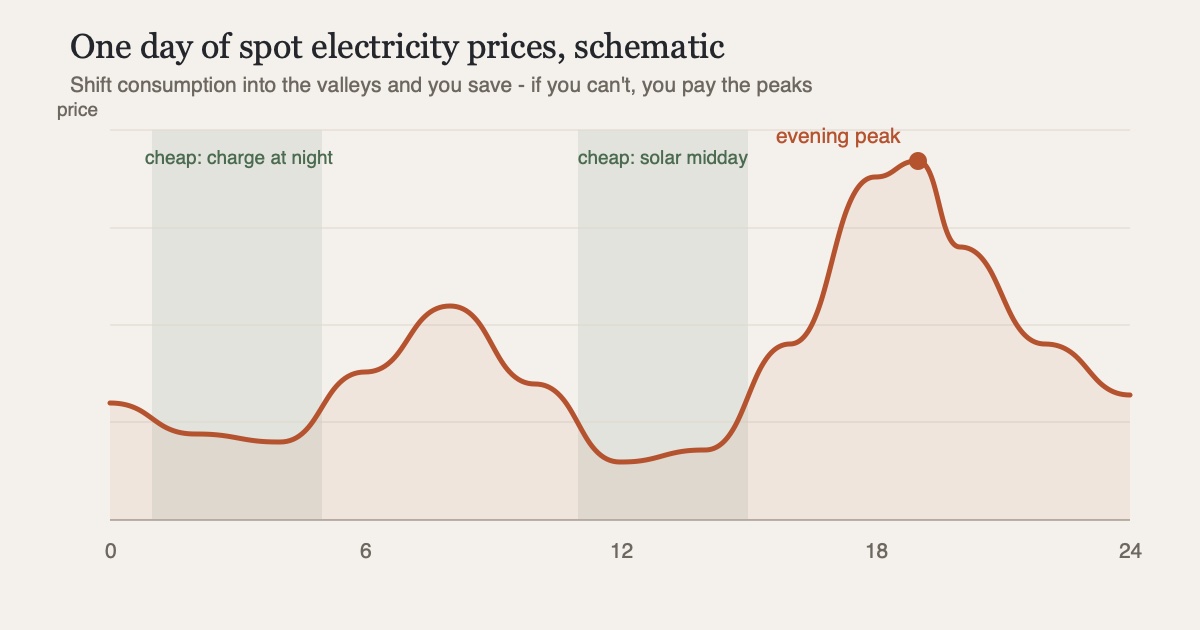
On the exchange, electricity has a different price every hour: sometimes almost nothing at noon when the sun is out, a multiple of that on dark winter evenings. Dynamic electricity tariffs pass these swings straight through to households. Since January 1, 2025, every German electricity supplier has been legally required to offer such a tariff, and providers like Tibber, Ostrom and awattar have built their entire business model on it. So who actually comes out ahead?
How dynamic tariffs work
Instead of a fixed rate per kilowatt-hour, you pay the exchange price (day-ahead auction), usually by the hour, plus the provider's margin and a base fee. To keep expectations in check, remember that the exchange price is only part of your electricity price. Taxes, levies, surcharges and grid fees are fixed and, according to the German consumer protection agency, usually make up the largest share. Even when the exchange price drops to zero, the kilowatt-hour is not free.
The technical prerequisite is a smart meter that transmits consumption in 15-minute intervals. Since January 2025, households can demand its installation from their metering operator. The technology is still far from widespread, though: at the end of 2025, only about 3.1 million smart metering systems were installed in Germany, roughly 5.5 percent of all metering points. For many households, the smart meter bottleneck, not the tariff, is the real hurdle.
What the numbers say
The most thorough calculation to date comes from a study by Neon Neue Energieökonomik commissioned by the utility Naturstrom (October 2025). Its core results:
- Households without shiftable loads save only 1 to 4 percent with a dynamic tariff, because everyday consumption (cooking, lights, laundry) simply can't be moved much
- EV with smart charging: around 31 percent savings on charging costs; the car is parked most of the time anyway, so it hardly matters when it charges
- Heat pump: about 7 percent, more with a buffer tank and adapted controls
- Combined with time-variable grid fees under Section 14a of the German Energy Industry Act, the potential rises sharply: up to 82 percent of charging costs for the EV, 26 to 28 percent for the heat pump
The pattern is clear. The savings come from load shifting, not from the tariff itself. If you can't shift anything, the price signal does nothing for you.
The risk: you're out in the price rain
December 12, 2024 showed the flip side: during a "Dunkelflaute", with barely any wind and barely any sun, the day-ahead price rose to 936.28 euros per megawatt-hour in the evening hour, almost 94 cents per kilowatt-hour for the energy alone. Germany's grid regulator and cartel office investigated the spikes and found no market manipulation. That's simply the merit order under scarce supply. Such extreme hours are rare and short, but whoever has to cook, charge and heat at exactly that moment pays them in full.
The consumer protection agency adds the uncomfortable points: the price risk sits entirely with the household, the tariffs are hard to compare, and electricity costs become less predictable. Advertising claims like "save up to 500 euros a year" it considers unrealistic.
Who benefits and who doesn't
Good candidates:
- EV drivers with their own wallbox and smart charging control (by far the strongest case)
- Households with a heat pump and buffer tank, ideally combined with a Section 14a grid-fee module
- Owners of battery storage who can bank the cheap hours
- Anyone who can stomach price swings and enjoys optimizing
Rather not:
- Households without large shiftable loads, where 1 to 4 percent savings hardly justify the effort
- Anyone who needs fixed, predictable payments or doesn't want to deal with price apps
- Anyone without a smart meter facing an indefinite installation wait
Conclusion
Dynamic tariffs are a tool for households with flexibility, and for them a genuinely good one. They are no savings program for everyone. Economically they're desirable anyway: millions of households shifting their consumption into the generation peaks relieve exactly the grid whose bottlenecks I described in the post on battery storage as the backbone of the energy transition. But anyone who owns an EV plus wallbox today is leaving real money on the table with a fixed-price tariff.
Sources
- gesetze-im-internet.de: Section 41a EnWG, obligation for all suppliers to offer dynamic tariffs
- Bundesnetzagentur: Dynamic electricity tariffs - consumer portal, how they work and what they require
- Verbraucherzentrale: Dynamic electricity tariffs: who they pay off for, risks, fixed price components, assessment of advertising claims
- pv magazine: Study sees high savings potential from dynamic tariffs and time-variable grid fees, Neon study commissioned by Naturstrom with savings figures
- Neon Neue Energieökonomik: Household savings potential from dynamic electricity tariffs (PDF), full study
- energie-experten.org: Dark doldrums late 2024: high exchange prices, no market manipulation, price peak of 936.28 euros/MWh on Dec 12, 2024 and the regulators' investigation
- Bundesnetzagentur: Smart meter rollout, rollout status of intelligent metering systems