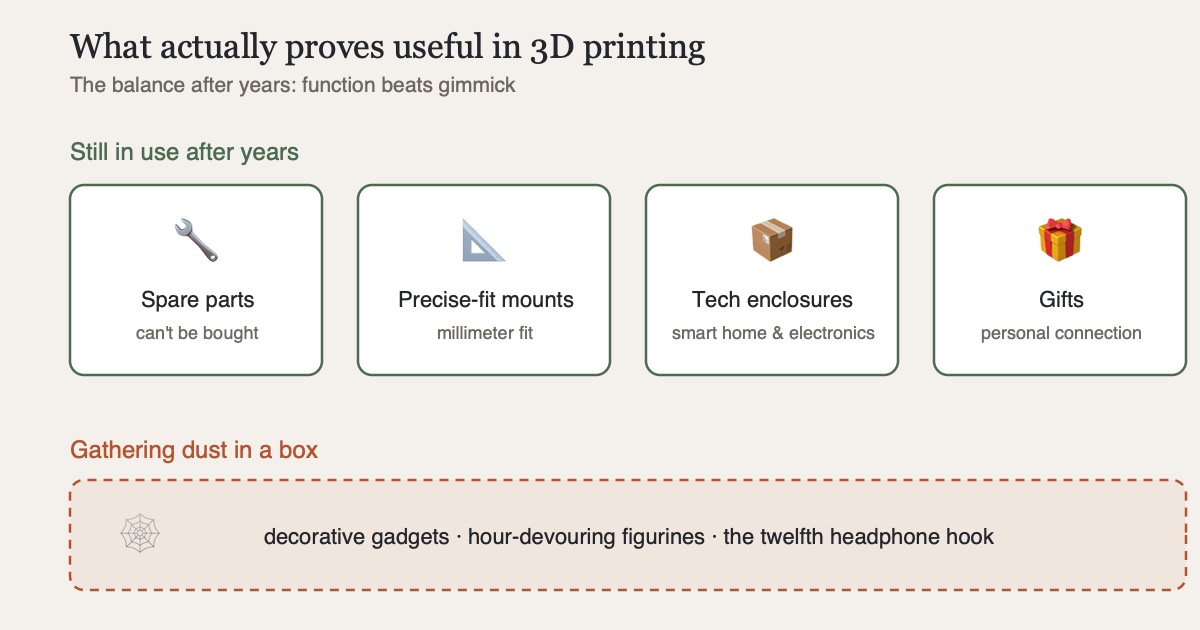
Anyone who buys a 3D printer prints a boat, a dragon and a phone stand in the first week - and then faces the real question: what is this thing actually good for? After years with several printers, countless spools of filament and a shop in the making, my balance sheet is clearer than the usual "50 best prints" lists suggest. This is not a gadget list but a field report: what stays, what gathers dust.
What proved its worth
1. Spare parts and repairs
The least spectacular category is the most valuable one. The snapped clip on the dishwasher rail, the lost end cap, the cracked bracket of a window blind - parts you can't buy individually, or only as a complete assembly for 40 euros. Twenty minutes of CAD, thirty minutes of printing, problem solved. Not because printing is cheaper than buying, but because the part isn't available to buy at all. That's exactly where 3D printing beats every other manufacturing method in the household.
2. Precise-fit mounts and organizers
The second evergreen category lives off a single advantage: millimeter fit for exactly your case. The mount that fits precisely into this one drawer. The organizer that holds exactly this tool. The shelf that sits exactly between two tiles. Store-bought universal solutions are always compromises - the print never is. The difference from the decorative gadget: these parts have a job, and they do it every day.
3. Enclosures and accessories for tech
As a smart home tinkerer, this is my home turf: sensor housings, cable guides, wall mounts for controllers, covers for flush-mount works in progress. Electronics projects without an enclosure end up as a flying rig on a shelf - with a printer, every project gets a clean, precise-fit home. Materials knowledge pays off here too: PLA for everything indoors, PETG as soon as heat or moisture is involved, TPU for anything that should dampen or seal. The details are in my materials database.
4. Gifts with a personal connection
The category that surprised me the most - and the one from which my small shop "Nerdwana" is currently emerging. A printed gift doesn't win through perfection but through connection: the model of a favorite motif, the reference, the inside joke. Mass-produced goods can't do that. Platforms like Printables and MakerWorld provide an almost inexhaustible pool of community designs for it.
What gathers dust
Honesty is part of the balance. What did not prove worthwhile:
- Decorative prints without function. The low-poly animal became invisible after a week and boxed up after a year
- Printing what's better bought ready-made. A printed measuring cup is worse than a two-euro one - food safety included
- Hour-devouring figurines. Twenty hours of print time for a collectible that never gets painted after all
- "Useful" gadgets from lists. The twelfth headphone hook and the showerhead adapter nobody needed - printed because it was possible, not because it was missing
The pattern behind it: a print proves itself when it solves an existing problem. It gathers dust when the printer invented the "problem" in the first place.
The honest economics
Does a 3D printer pay for itself? Through saved purchases: rarely. Filament, electricity, failed prints and your own time add up, and much of it would be cheaper bought ready-made. The calculation works out differently: the printer produces solutions that can't be bought - the exact spare part, the millimeter-precise mount, the personal gift. If you measure the value in "replaced Amazon orders", you'll be disappointed. If you measure it in solved problems, you understand why the printer is still running after years.
Conclusion
My 3D printer evolved from toy to tool - with a learning curve that was less about technology than about the question of what is worth printing. The answer after years: repairing beats decorating, fit beats variety, function beats gimmick. And if you have an idea but no printer: I take on custom designs and small production runs on request.
Sources and links
- My maker page: 3D printing & smart home - services, print projects and the materials database with temperature guidelines for PLA, PETG, ABS, TPU and more
- Printables: printables.com - Prusa's community design platform, source of many proven functional models
- MakerWorld: makerworld.com - design platform with a large pool of everyday solutions