App
Tsugi: a Dominosa Puzzle, Mended in Gold
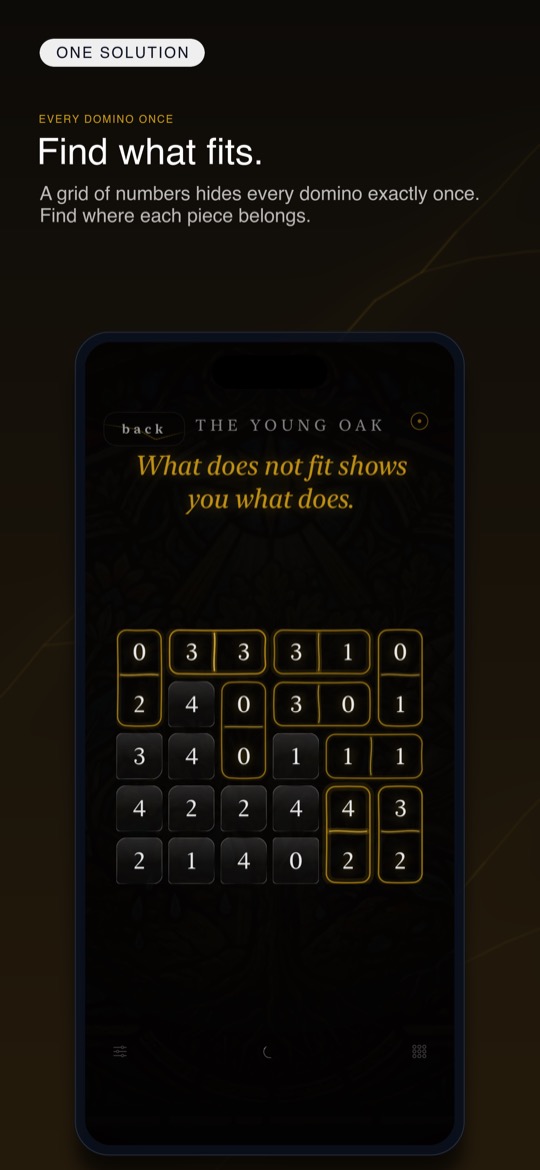
Tsugi is a dominosa puzzle for iPhone and iPad that I build on my own. A grid of numbers hides every domino exactly once, and your job is to find where each piece belongs. Every board has a single solution, none of it is guesswork, and no clock is running while you think. Buy it once and all nine levels and unlimited hints are there from the start.
What it looks like
What is dominosa?
A complete set of dominoes has been laid out on a rectangular board, but the edges of the pieces have vanished. Only the numbers are left. Every pair of numbers appears exactly once in the set: 0 with 0, 0 with 1, 1 with 4 and so on. The task is to split the board into horizontal and vertical pairs so that every domino lies there exactly once.
In Tsugi you tap one stone, then its neighbour, and the two join into a pair. The real work is ruling things out: once a pair has been placed, it cannot appear anywhere else, and a cell with only one neighbour left is settled. What does not fit shows you what does.
Nine levels, from seed to oak
Story mode takes you through nine levels, and their names form one picture together: a tree that grows from a seed through sapling and young oak to its crown, and ends as an old oak. Each level adds one number, and with it pairs that did not exist before.
The first level gets by with three dominoes. On the last one, The Oak, 55 dominoes with the numbers 0 to 9 lie on a board of 10 by 11. In between, the board grows by one row and one column with every level. The first two levels come with a short in-game introduction; after that, each board carries only a single line that belongs to its level.
Three ways to play
Story mode takes the nine levels in order, from the smallest board to The Oak. If you want to start your progress there from scratch, you can reset the story in the settings, after a confirmation.
Unlimited opens every level at any time, with nothing to finish first. It is the mode for anyone who likes one particular size best.
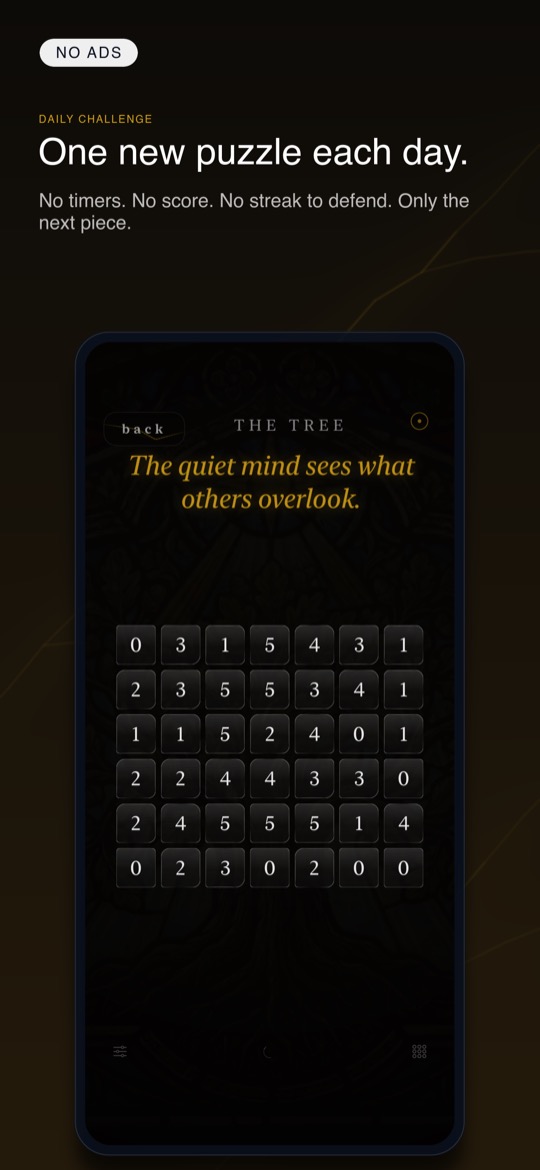
The Daily Challenge brings one new puzzle each day. It is deliberately not a streak to defend: skip a day and you lose nothing.
Hints without limit
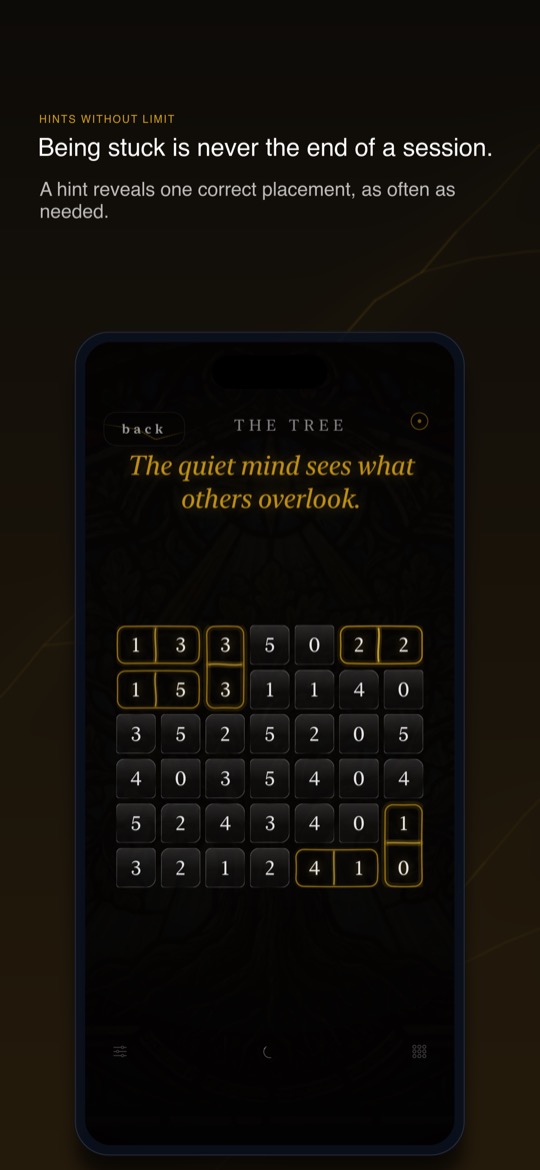
A hint reveals one correctly placed domino, as often as you need. There is no supply that has to refill first and no purchase that unlocks more hints. Being stuck is never the end of a session.
Two small helpers come with it. Undo lifts the domino you placed last. The pair tracker shows which pairs are already on the board and which are still to find, which saves a lot of searching on the larger boards in particular.
Mended in gold: where the name comes from
The name comes from kintsugi, the Japanese art of repairing broken pottery with gold. The break is not hidden but highlighted: the flaw becomes the ornament.
That is exactly what happens in the game. A solved board seals its seams in gold, and a field of loose numbers becomes one whole. The seam is the strongest part.
Quiet by design
No timers. No score. No streak to defend. Tsugi is built for the moments when a puzzle is meant to calm you down rather than to be won: at the end of the day, or during a deliberate pause.
Sound and haptics accompany the game, and each can be switched off on its own in the settings. If you prefer silence, you are left with nothing but the numbers.
Pay once, nothing is sent
Tsugi costs something once and never again: no ads, no in-app purchases, no subscription, no account, no tracking. The app sends nothing anywhere, and your progress stays on the device.
The whole app is translated into 44 languages, board, levels and settings included. On iPad the game gets a bigger board, built for the bigger screen. VoiceOver reads every cell by row, column and value, every control carries a label, and animations follow Reduce Motion.
Frequently asked questions
How do you play dominosa? The board is made of numbers that together form a complete set of dominoes. You join two neighbouring numbers into one domino at a time until the whole board is covered and every domino appears exactly once.
Does every puzzle have exactly one solution? Yes. Every board can be solved by reasoning alone, without guessing at any point. Why a single solution takes so much work when you build logic puzzles is explained in Building Logic Puzzles With Exactly One Solution.
Are there in-app purchases? No. Since version 2.0, all nine levels and unlimited hints come with the purchase of the app.
Does Tsugi run on iPad? Yes, with a larger board of its own.
Do I need an internet connection? No. Tsugi runs fully offline and sends nothing.
Related
Tsugi: Zen Dominosa Puzzle is on the App Store as a one-time purchase with no in-app purchases.