App
NonoQuest: Nonograms in the Look of Old Handhelds
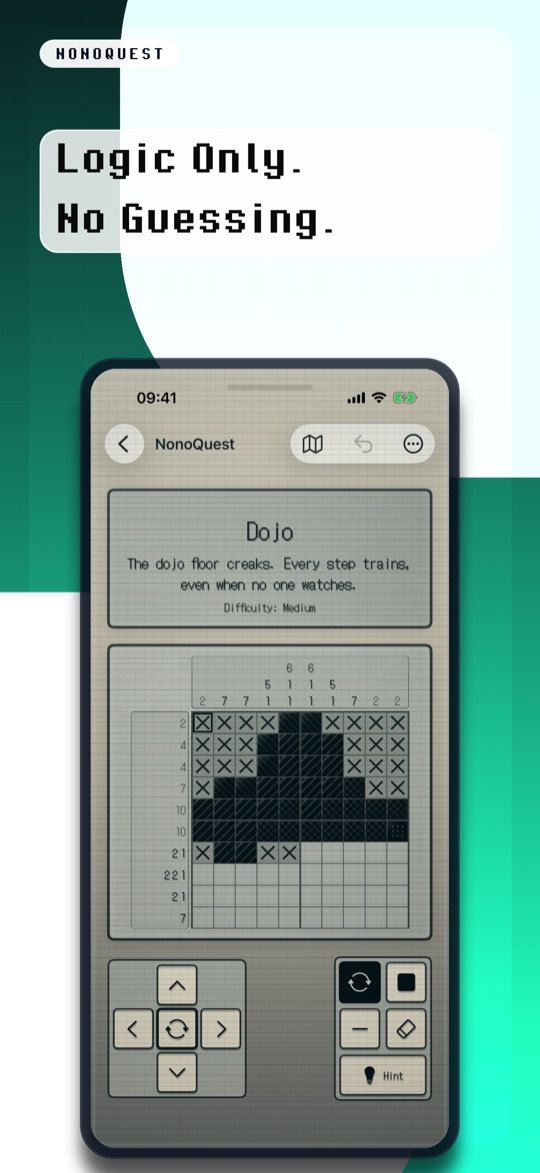
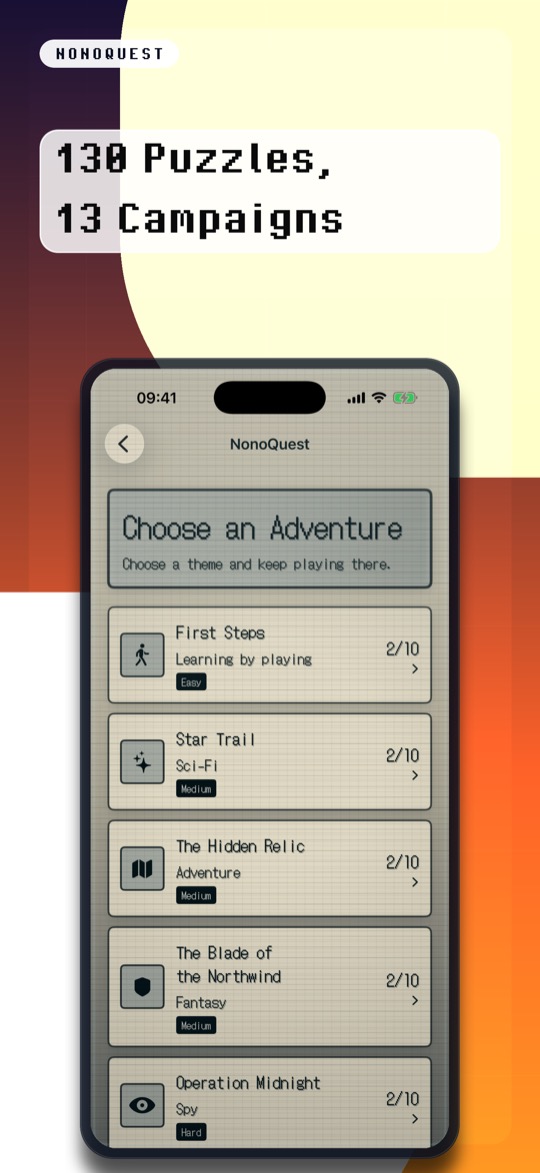
NonoQuest is a nonogram game for iPhone that I build on my own: 130 handcrafted picture puzzles across thirteen campaigns, styled like an old handheld and with a small story for every puzzle. Each one works out with logic alone; you never have to guess. On top of that come a Puzzle of the Day, an endless mode and an album where every solved picture stays.
What it looks like
What is a nonogram?
A nonogram is a picture puzzle on a grid. Along every row and every column there are numbers, and each number is a block of filled cells that appears in that line, in exactly that order and with at least one empty cell in between. A 3 means three black cells right next to each other. Think every line through to the end and a pixel picture appears.
The idea goes by many names: picross, griddler, hanjie or Japanese crossword. It is always solved the same way. You look for the places where a block can only fit its line in one way, fill them, cross out what is certainly empty, and gain information for the columns that cross it.
130 puzzles in 13 campaigns
The puzzles are built by hand, not generated, and spread across thirteen campaigns of ten each. Every campaign has a theme, from science fiction through fantasy and adventure to a spy mission, and every puzzle has a name and a line of story. The solved picture belongs to that story.
Grids range from 5x5 to 20x20, from a puzzle for five minutes to one for a whole evening. The First Steps campaign introduces the game one technique at a time. Every other campaign is open from the start: if you get stuck in one, just carry on in another.
Four-step help that teaches something
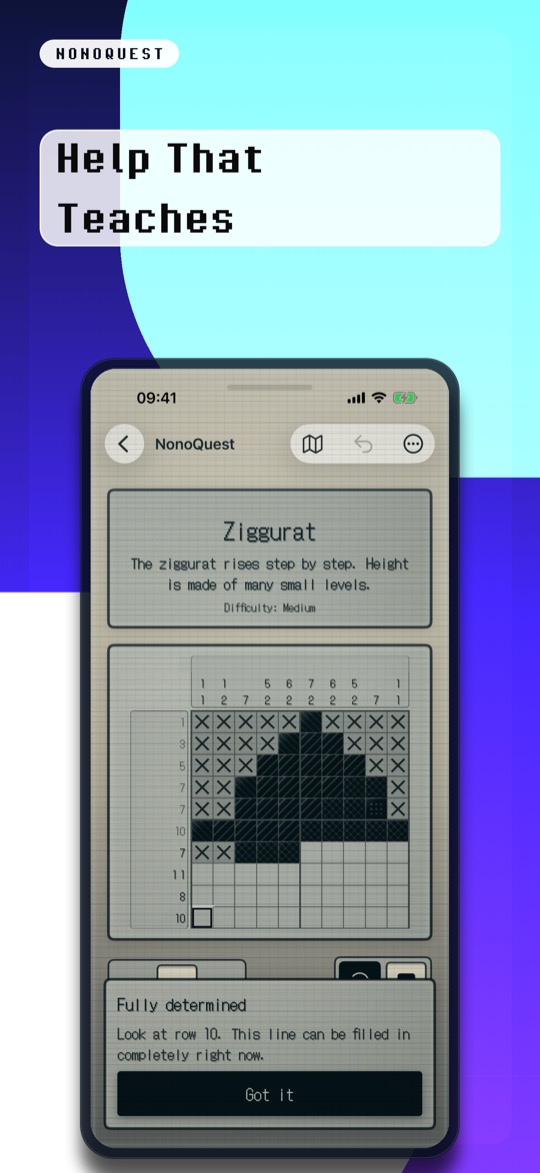
Most nonogram apps know only one kind of help: reveal a cell. NonoQuest starts somewhere else. The first step names the technique and the place where it applies right now, such as “Look at row 10. This line can be filled in completely right now.” Then come the questions “Where do I go next?” and “Is anything wrong?”. Only the fourth step shows a cell.
So the first three steps give away no answer; they show you how to get there yourself. If after a few puzzles you notice you hardly need the help any more, you have learned exactly what the game sets out to teach.
Spot mistakes early, undo any move
A full line that does not match its numbers gets flagged before half an hour of work builds on it. How clearly that happens can be set in three steps, from Relaxed to Purist. Purist means no feedback at all: you find every mistake yourself.
Any move can be undone, up to 200 moves back. A drag across the board counts as one move, even if it fills twenty cells. You fill cells by tapping or dragging, and if you prefer precision, the directional pad moves the selection while the buttons switch between fill, cross and eraser.
Puzzle of the Day, endless mode and album
The Puzzle of the Day is the same for everyone worldwide, and it gets bigger towards the weekend. Your run of solved days counts up, but nothing punishes a missing day.
Endless mode is meant for the time after the 130 puzzles: pick one of five sizes and keep going. Nothing is recorded there; it is just for playing.
The album keeps every solved picture in view, sorted by campaign and with progress bars. A solved picture can be shared as a tile, and if you want to play a puzzle again, you start it from there on an empty board without the picture leaving your album.
Seven display modes inspired by classic hardware
The retro look is not a filter on top of a modern interface. Each of the seven display modes has its own pixel font, dot pattern and scanline structure: besides a plain Clean mode, there are nods to the Apple II, Atari, Amiga OS, Game Boy, Sharp X68000 and the DEC VT220 terminal with its warm afterglow.
There is sound as well, made of generated tones as an extra. It is off by default and can be switched on if you want it.
Playable with VoiceOver, Switch Control and a keyboard
A grid puzzle that can really be played without looking at the screen is rare. NonoQuest is fully playable with VoiceOver, Switch Control and a keyboard. Every grid cell speaks its position, its state and the clue numbers of its row and column.
It fits that the game measures nothing that puts you under pressure: no timed scoring, no leaderboard, no lives and no energy waiting to refill.
Offline, no ads, no in-app purchases
NonoQuest is bought once and then runs fully offline. There are no ads, no in-app purchases, no subscription and no account. Your progress is saved on the device.
Frequently asked questions
Do you ever have to guess in NonoQuest? No. Each of the 130 puzzles can be solved with line logic alone, and a solver checks that on every test run. The same goes for the Puzzle of the Day and endless mode. Why that is not a given with logic puzzles is explained in Building Logic Puzzles With Exactly One Solution.
Do I have to play the campaigns in order? No. First Steps is meant as the way in; every other campaign is open from the start.
I have never solved a nonogram. Can I get into it? Yes. A guided tutorial explains the controls and the edge numbers with small exercises, and the First Steps campaign builds up the techniques one after another.
Which devices does NonoQuest run on? iPhone and iPad with iOS 17 or later.
Are there in-app purchases or ads? No, neither.
Related
NonoQuest is on the App Store as a one-time purchase with no ads and no in-app purchases.