Part 7 of the series "Smart Home in Practice". Part 1 explained why the setup runs locally, parts 2 to 5 brought the heat pump onto the local hub, Part 6 introduced the energy management; Part 8 takes stock of 25 automations.
If a smart home earns real money anywhere, it is here. Switching lights from an app is convenience - but wiring solar power, batteries and hourly exchange prices into a system that independently decides where energy flows every day: that is the point where the hub from Part 1 pays for itself.
The ingredients: three roof faces, three batteries, one price
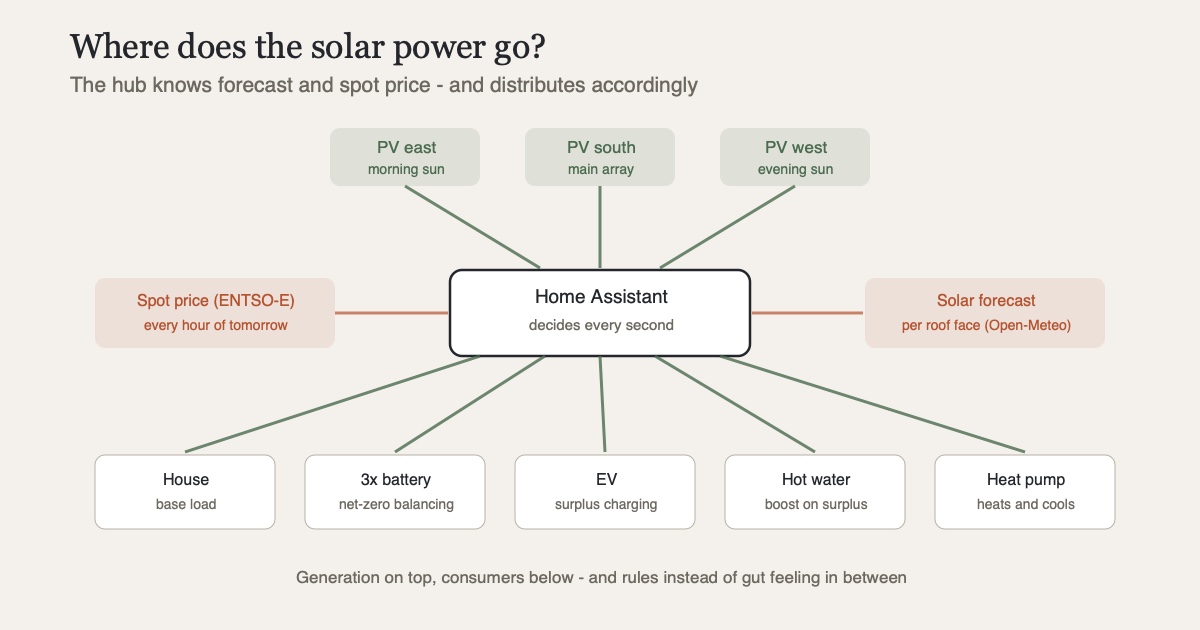
The generation side: photovoltaics on three orientations - south, east and west. That flattens the production curve across the day but also makes it harder to predict, which is why forecasts play a leading role later. The SolarEdge inverter is not connected through the vendor cloud but locally via Modbus TCP - readings every few seconds, without a single byte leaving the house. A small APsystems array complements it.
The storage side is unconventional: three Zendure Hyper 2000 units, plug-in batteries totalling a good 11.5 kWh, integrated locally through a community project. Instead of the vendor app, Home Assistant controls them as a group.
The third ingredient is the price. Through an ENTSO-E integration, the hub knows the day-ahead prices from the European transparency platform for every hour of the next day. Whether dynamic tariffs are worthwhile in general, and for whom, is a separate article - this one is about what a smart home makes of them.
Net-zero balancing: the meter should read zero
At the core of the storage control is an automation with the sober name "balance control". The idea: a meter at the grid connection reports every second whether the house is currently importing or exporting. The hub adjusts the three batteries so that this balance stays as close to zero as possible - surplus goes into the packs, demand is served from the packs. It sounds trivial, but with three devices in a group it is a lovely control problem: who charges first, who discharges first, what happens at full load, and how do you keep the loop from oscillating?
Exactly this kind of logic is why the batteries have to be connected locally. A control loop that should react every second cannot run through a manufacturer's cloud on another continent.
Forecasts: knowing today what the roof delivers tomorrow
The second source of information besides the price is the solar forecast. Open-Meteo provides a production forecast per roof face - separately for south, east and west. Only the combination of both makes the control forward-looking: if plenty of sun is forecast for tomorrow noon, the battery does not need a full overnight charge from the grid, even if power is cheap at night. If a grey week is coming, topping up in the cheapest night hour pays off.
The automations: car, hot water, heat pump
On this foundation run the actual decision-makers - a handful of automations choreographing the big consumers:
- Solar surplus charging for the EV: the automation detects a car at the plug and adjusts the charging current proportionally to the surplus - more sun, faster charging. A safety automation aborts if the home battery drops below a minimum: the car should get the surplus, not the house's reserve.
- Hot water as a battery: if the roof produces more than house and packs can absorb, the heat pump heats the domestic water beyond comfort temperature - energy stored in water instead of lithium. A built-in legionella protection makes sure the hygiene cycle still happens regularly, and the boost stays off at night.
- Heat pump by outdoor temperature and flow curve: the hub switches between heating and cooling and adjusts the flow temperature - in summer the underfloor circuits even cool, governed by per-room PID thermostats.
- Bookkeeping on the side: utility-meter helpers automatically split the heat pump's consumption into heating, cooling and hot water. That sounds like administration, but at the end of the year it answers where the kilowatt-hours actually went - and Home Assistant's energy dashboard turns it into charts.
What this system is not
A note for perspective: none of this is an off-the-shelf product, and that is precisely the catch. The building blocks come from the official catalog, from HACS and from GitHub repositories; the logic is home-grown and wants maintenance. If you are looking for a zero-maintenance solution, a commercial home energy management system will make you happier. But if you want to understand where your energy goes - and why millions of such flexible households matter for the grid as a whole - this construction kit is hard to beat.
The eighth and final part gets more mundane: 25 automations in stock - which ones proved themselves, which are mere gadgetry, and what there was to learn.
Sources
- ENTSO-E: Transparency Platform - official day-ahead prices of the European power exchanges
- GitHub: hass-entso-e - community integration for ENTSO-E prices in Home Assistant
- Open-Meteo: weather and solar API - free forecast data behind the production prediction
- GitHub: home-assistant-solaredge-modbus - local inverter connection via Modbus TCP
- GitHub: Zendure-HA - integration of the Zendure batteries into Home Assistant
- Home Assistant: Home Energy Management - the energy dashboard